
KAIST Develops Advanced Quadrupedal Robot with Enhanced Sensory Perception
KAIST has introduced DreamWaQ++, a quadrupedal robot technology capable of terrain perception using cameras and LiDAR sensors. This advancement represents a significant leap in robot autonomy, with applications in disaster response and industrial inspections.
 Theia Market Signal Identification - AI Assisted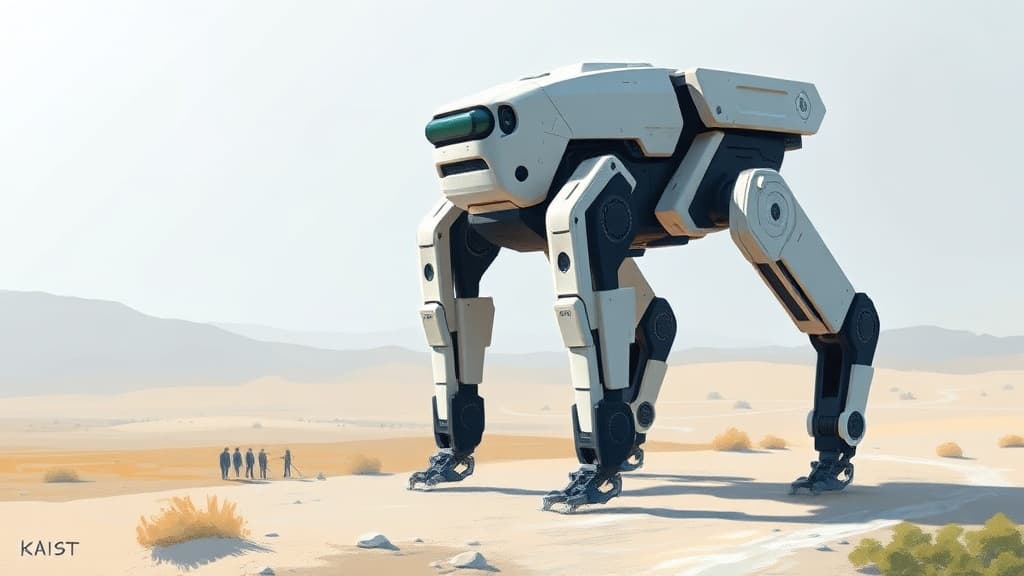
KAIST's research team has launched DreamWaQ++, a quadrupedal robot control technology that utilizes cameras and LiDAR for real-time terrain perception and locomotion strategy adjustments. This builds on the previous DreamWaQ, which relied solely on proprioceptive sensing for movement in challenging environments without visual input.
DreamWaQ++ enhances this by enabling proactive obstacle recognition and decision-making, employing a multimodal reinforcement learning architecture. Experiments showed the robot could navigate 50 steps in 35 seconds and successfully climb a 35° incline, outperforming existing technologies.
Its ability to autonomously choose paths and adapt to obstacles demonstrates its potential for applications in hard-to-reach areas like disaster sites and agriculture. The research was published in IEEE Transactions on Robotics, highlighting the progress in autonomous robotic capabilities.



Comments