
NASA’s IMAP Mission Set to Illuminate the Heliosphere and Enhance Space Weather Monitoring
NASA is poised to launch its Interstellar Mapping and Acceleration Probe (IMAP) on September 23, alongside two other missions, from Kennedy Space Center. IMAP aims to explore the heliosphere's boundaries, studying the solar wind and its interactions with interstellar space. Utilizing ten scientific instruments, the mission will provide insight into high-energy particles and magnetic fields, while offering real-time monitoring of space weather to protect technology and astronauts from hazardous conditions.
 Theia Market Signal Identification - AI Assisted
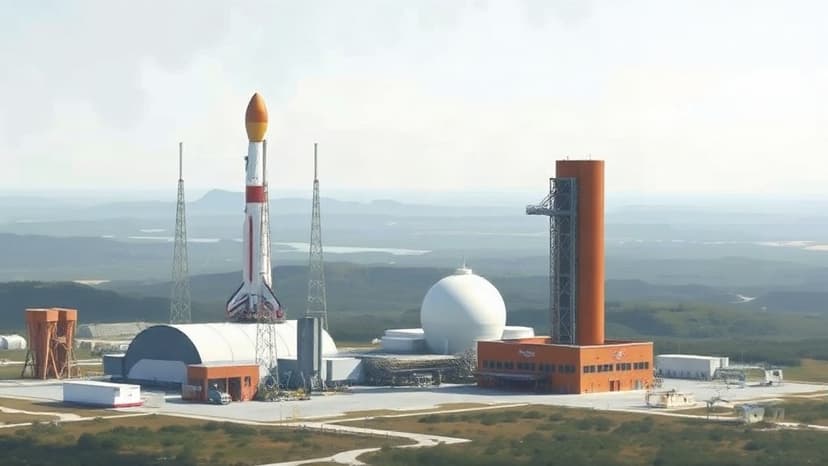
NASA is preparing for a significant milestone in heliophysics with the upcoming launch of its Interstellar Mapping and Acceleration Probe (IMAP) on September 23. Set to lift off from the Kennedy Space Center aboard a SpaceX Falcon 9 rocket, IMAP will join two other missions, including NOAA's SWFO L1 space weather observatory and NASA's Carruthers Geocorona Observatory, in a collaborative effort to deepen our understanding of the cosmos.
IMAP's mission is nothing short of ambitious; it seeks to chart the enigmatic boundaries of the heliosphere—a vast bubble created by the solar wind that envelops our solar system. This mission will not only map the solar wind's interactions with the local galactic environment but will also investigate how charged particles from the sun are energized, contributing to essential questions in heliophysics.
Equipped with ten advanced scientific instruments, IMAP will create a comprehensive picture of the interplanetary space landscape, examining everything from high-energy particles emitted by the sun to the magnetic fields that permeate this vast expanse. One of its primary objectives is to understand the dynamics at the heliosphere's boundary, a critical zone that shields our solar system from the galaxy's harsher radiation, thereby maintaining conditions conducive to life on Earth.
In addition to its exploration objectives, IMAP will serve a practical purpose by providing real-time observations of solar wind activity. This capability is crucial for protecting spacecraft and astronauts in the near-Earth environment, as it can offer a vital warning—approximately a half hour in advance—of incoming radiation that poses risks to both technology and human safety.
Stationed at the first Earth-Sun Lagrange point (L1), roughly one million miles from Earth, IMAP is set to enhance our understanding of space weather and its potential impacts on global communications and electrical infrastructure. As a modern celestial cartographer, IMAP's findings could reshape our knowledge of the interplay between solar activity and the broader cosmic environment, paving the way for future explorations beyond our solar system.


Comments