
NASA's Hubble Telescope Discovers Candidate Dark Galaxy CDG-2 Rich in Dark Matter
Astronomers have identified Candidate Dark Galaxy-2 (CDG-2) using the Hubble Space Telescope, believed to consist of at least 99.9% dark matter. Located approximately 300 million light-years from Earth, CDG-2 may belong to a class of galaxies with few or no stars. Researchers utilized data from Hubble, the European Space Agency's Euclid space observatory, and the Subaru Telescope to make this discovery. Further observations are needed to confirm its dark matter content and properties.
 Theia Market Signal Identification - AI Assisted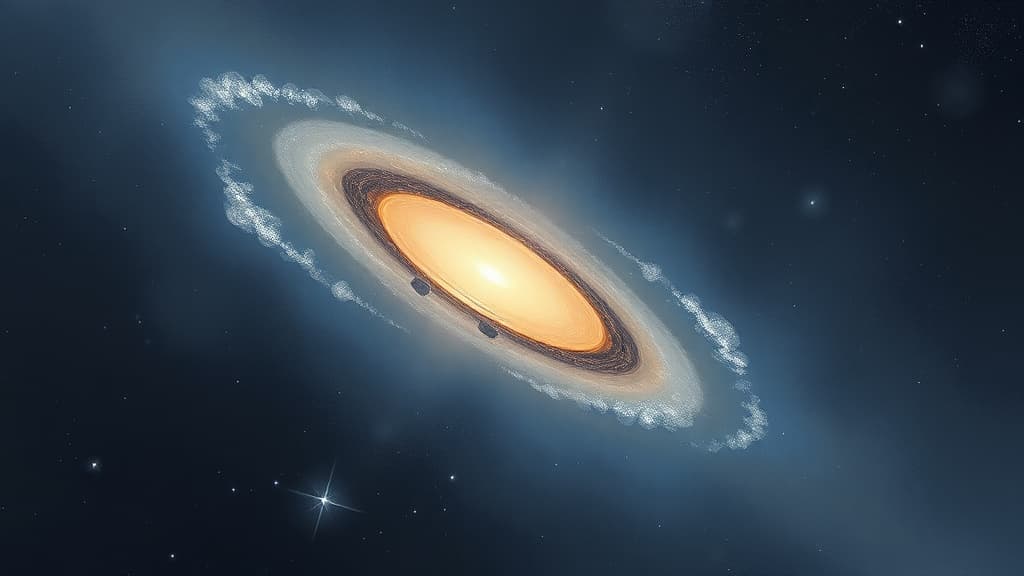
Candidate Dark Galaxy-2 (CDG-2) has been discovered by astronomers using the Hubble Space Telescope, with indications that it is composed of at least 99.9% dark matter. Positioned around 300 million light-years from Earth, CDG-2 could represent a rare type of low surface brightness galaxy known as a dark galaxy, which may contain minimal to no stars.
The discovery relied on observations from Hubble, the Euclid space telescope, and the Subaru Telescope in Hawaii. Researchers identified four globular clusters in the Perseus Cluster, suggesting the presence of CDG-2, which appears to have very few stars due to hydrogen gas depletion by larger galaxies. This finding could provide insights into dark matter behavior, necessitating further observations to determine CDG-2's properties using advanced telescopes like the James Webb Space Telescope.




Comments