
New York to test world's first hydrogen-fueled power generator
A Long Island power station will host a pioneering hydrogen technology that produces electricity without burning fuel. Utility National Grid is installing the world's first 100% hydrogen linear generator, aiming to show that hydrogen can serve as a zero-emission substitute for peaking power plants. The year-long trial will gauge performance and could inform how to keep grids reliable in a post-fossil future.
 Theia Market Signal Identification - AI Assisted
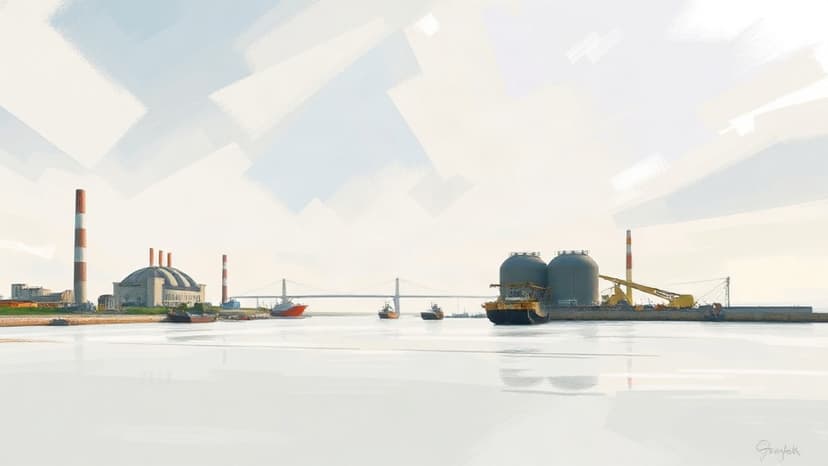
The towering Northport Power Plant on New York's Long Island – traditionally fueled by oil and gas – is about to pilot a glimpse of the future. National Grid Ventures, the innovation arm of the utility company, announced it will install the world's first 100% hydrogen-fueled commercial linear generator at the Northport site[76].
This novel generator, expected to be operational by September 2026, uses hydrogen in a flameless chemical reaction to generate electricity, rather than conventional combustion[77]. In effect, it converts hydrogen's chemical energy to power without burning it, meaning zero NOx or CO₂ emissions at point of use[77]. The project is supported by the New York State Energy Research and Development Authority (NYSERDA) and the Long Island Power Authority (LIPA), underscoring the public-private interest in proving hydrogen as a clean backup power solution[78].
The linear generator is being provided by California-based startup Mainspring Energy. Unlike a typical engine or turbine, Mainspring's generator has no pistons or rotating turbine blades. Instead, it uses linear oscillating magnets and coils (driven by the expanding gases from a hydrogen reaction) to produce electrical current.
The design can flexibly run on various fuels – biogas, ammonia, natural gas – but this pilot will use green hydrogen exclusively[77][79]. Over a 12-month test period, engineers will put the 250 kW unit through its paces, simulating the duty cycle of a peaking power plant that kicks in when electricity demand spikes (for example, on hot summer afternoons when air conditioners roar)[77].
Because the linear generator operates at low temperature without flames, it can ramp up and down quickly and is expected to have lower maintenance needs. The key question: Can it deliver power reliably and cost-effectively to help balance a grid that increasingly relies on intermittent renewables?
New York is an ideal laboratory for this experiment. The state has one of the nation's most aggressive clean energy targets – a carbon-free electricity grid by 2040. Achieving that means retiring natural gas peaker plants that currently ensure reliability on high-demand days.
According to the New York grid operator, the state will need at least 20 GW of Dispatchable Emission-Free Resources (DEFR) by 2040 to replace fossil fuel plants and maintain grid stability[80]. Technologies for that role are still emerging, and hydrogen-fueled generators are a prime candidate.
"This hydrogen-fueled linear generator is the world's first and an important step in developing the energy resources of tomorrow," said Will Hazelip, president of National Grid Ventures US[81]. Unlike a battery which discharges for only a few hours, a hydrogen generator can, in theory, run as long as fuel is supplied.
And unlike a gas turbine converted to hydrogen, the linear generator doesn't need complex retrofits or produce any combustion by-products. It can also switch fuels depending on availability – "avoiding burdening customers with unnecessary costs" if hydrogen is scarce or pricey, Hazelip noted[82].
The Northport pilot will be closely watched. Researchers at Stony Brook University's Advanced Energy Center are partnering to independently evaluate the generator's performance, emissions (which should be essentially zero apart from water vapor), efficiency, and noise levels[83][84].
They'll analyze how it responds to dynamic load demands and whether any hydrogen leakage or safety issues arise in real-world operation. The Department of Energy is interested too, as it looks to scale up hydrogen use through its national Hydrogen Hubs program.
If the trial succeeds, it could pave the way for deployments of larger units (Mainspring says its design is scalable to hundreds of MW) at other aging power plants. Particularly, coastal sites like Northport – which has infrastructure and proximity to hydrogen shipping routes – could evolve into clean "hydrogen peakers" that fill gaps when wind and solar ebb.
There are hurdles: sourcing truly green hydrogen in sufficient quantities is one (it must be produced via electrolysis using renewable power). Cost is another – currently, green hydrogen is several times more expensive than natural gas for the same energy.
But New York policymakers, backed by NYSERDA grants, are investing now to drive those costs down through innovation. As Doreen Harris, NYSERDA's CEO, put it, this project represents "a pivotal frontier" in building a resilient, zero-carbon grid, showing how hydrogen can step in to keep the lights on when needed[83]. Long Island's experiment may thus provide a template for cities worldwide: replacing the fossil-fueled safety net with a clean, hydrogen-powered one[77][82].



Comments