
India's Agrivoltaics Initiative Aims for Sustainable Food and Energy Solutions
India's agrivoltaics initiative aims to enhance food security and renewable energy production by utilizing land for both solar power generation and agriculture, with a potential capacity of 3,200 GWp. The initiative could help meet the country's 280 GW solar target by 2030, improve land productivity by 160%, and create approximately 110,000 jobs, despite initial cost challenges. A cohesive policy framework and strategic roadmap are essential for scaling agrivoltaics and addressing governance issues.
 Theia Market Signal Identification - AI Assisted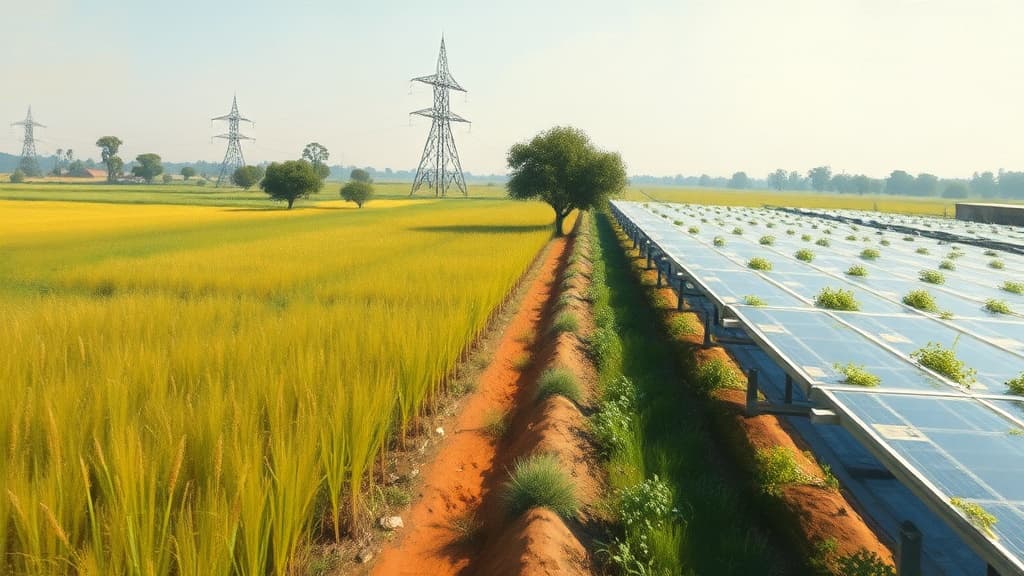
Agrivoltaics (APV) in India offers a solution for simultaneous renewable energy development and food security by utilizing the same land for solar power generation and agriculture. With a potential of 3,200 GWp, APV can help achieve India's target of 280 GW solar capacity by 2030, enhancing land productivity by 160% and creating an estimated 110,000 jobs with a moderate deployment of 20 GW.
Various APV configurations, such as overhead, inter-spatial, and vertical bifacial systems, maximize land use and crop diversity. Key states include Punjab, Haryana, and Rajasthan, with significant APV potential.
Despite higher initial costs, studies show favorable Levelized Cost of Energy (LCOE) compared to traditional solar systems and promising payback periods. However, challenges include decentralized governance and a need for cohesive policy frameworks. A strategic roadmap is essential for scaling agrivoltaics, ensuring fair ownership, capacity building, and leveraging financial instruments.


Comments